
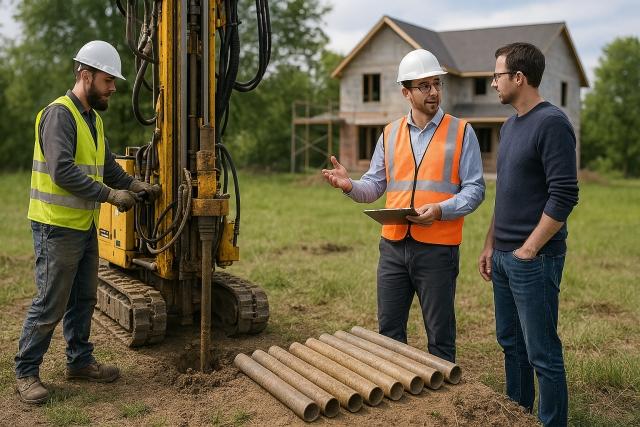
Building a safe house starts with understanding the land. Before construction begins, builders need to check the soil.
Soil testing helps engineers understand the strength and condition of the ground. It also shows the amount of moisture in the soil.These details help engineers choose the right foundation for a house.
In Kerala, soil conditions differ from one place to another. Some areas have laterite soil, while others have clay, sand, or waterlogged ground.Therefore, soil testing is an important step before building a house.
In this article, we will explain why soil testing matters. We will also discuss common testing methods, soil types, and the role of builders.
1. What Is Soil Testing in Construction?
Soil testing is the process of examining the soil at a construction site to understand its physical and engineering properties. It helps engineers determine whether the ground is suitable for supporting a proposed building and what type of foundation may be appropriate.
During soil testing, professionals examine different properties, such as:
Soil composition and classification.
Soil bearing capacity.
Moisture content.
Soil density.
Groundwater conditions.
Soil strength and settlement characteristics.
The results are recorded in a soil investigation report, which helps engineers plan the foundation safely.
2. Why Is Soil Testing Important Before Building a House?
Soil testing plays an important role in the early planning stage of construction.
Identifies Soil Strength
It helps determine the soil’s ability to support the weight of the proposed building.
Helps Select the Right Foundation
Different soil conditions require different foundation solutions. Soil investigation helps engineers select a suitable foundation system.
Reduces the Risk of Foundation Problems
Understanding ground conditions can help reduce the risk of excessive settlement, foundation movement, and related structural damage.
Helps Estimate Construction Requirements
Soil investigation findings help engineers plan foundation dimensions and construction requirements more accurately.
Improves Building Safety
Proper soil investigation supports safer structural design and more reliable construction planning.
3. Different Types of Soil Found in Kerala
Kerala has different soil types depending on the geographical location, elevation, and local environmental conditions.
Some commonly encountered soil types include:
Laterite Soil
Laterite soil is commonly found in many parts of Kerala. Its engineering properties can vary depending on weathering, moisture, and local ground conditions.
Clay Soil
Clay soil contains fine particles and can retain significant amounts of water. Some clay soils may shrink or swell depending on moisture changes.
Sandy Soil
Sandy soil has larger particles and generally allows water to drain more easily. Its stability depends on density and groundwater conditions.
Alluvial Soil
Alluvial soil is found in river valleys and low-lying areas. Its properties can vary depending on the deposited materials.
Organic Soil
Organic soil contains decomposed plant materials and may have poor load-bearing characteristics. It requires careful investigation before construction.
Important: Soil type alone does not determine foundation suitability. A geotechnical investigation is needed to understand the actual ground conditions.
4. Common Soil Testing Methods Used in Construction
Different testing methods are used to examine soil conditions at construction sites.
Standard Penetration Test (SPT)
SPT is a commonly used field test to assess soil resistance to penetration. It provides information useful for evaluating subsurface soil conditions.
Cone Penetration Test (CPT)
CPT uses a cone-shaped instrument pushed into the ground to measure soil resistance and provide information about subsurface layers.
Soil Bearing Capacity Test
This assessment helps engineers evaluate the ground’s ability to support foundation loads. The appropriate investigation or test method depends on the site and project requirements.
Moisture Content Test
This test determines the amount of water present in a soil sample and helps understand its condition.
Grain Size Analysis
This test identifies the distribution of different particle sizes in a soil sample and helps classify the soil.
5. How Does Soil Testing Help in Foundation Design?
Foundation design is directly influenced by the soil conditions at the construction site.
After receiving the soil investigation report, structural and geotechnical engineers evaluate the findings before selecting a suitable foundation system.
Some commonly used foundation types include:
Isolated footing: Used to support individual columns where ground conditions are suitable.
Combined footing: Supports two or more columns when required by the design.
Strip footing: Commonly used to support load-bearing walls.
Raft foundation: Distributes building loads across a larger foundation area.
Pile foundation: Transfers building loads to deeper, suitable soil or rock layers.
The final foundation selection depends on soil properties, building loads, groundwater conditions, settlement requirements, and engineering design.
6. Problems That Can Occur Without Proper Soil Testing
Skipping proper soil investigation can increase the risk of construction and foundation-related problems.
Foundation Settlement
When soil cannot adequately support the building loads, uneven or excessive settlement may occur.
Wall Cracks
Foundation movement can cause cracks in walls, floors, and other building components.
Water-Related Problems
High groundwater levels and poor drainage conditions can create moisture-related challenges around foundations.
Structural Instability
Inadequate understanding of ground conditions can result in unsuitable foundation design and potentially affect building stability.
Unexpected Construction Costs
Unexpected ground conditions may require foundation modifications, additional engineering work, and increased construction expenses.
7. Soil Testing Process Before Starting Construction
Soil testing generally follows a systematic process.
Site inspection: Engineers examine the construction location and surrounding ground conditions.
Soil sample collection: Soil samples are collected from selected locations and depths.
Field testing: Suitable tests are conducted to understand underground soil conditions.
Laboratory testing: Samples are examined to identify soil properties.
Report preparation: Testing results and engineering observations are documented.
Foundation planning: Structural and geotechnical engineers use the report to develop an appropriate foundation design.
The number of boreholes, testing depth, and investigation methods depend on the building size, site conditions, and project requirements.
8. Role of Professional Builders in Soil Testing
Professional builders play an important role in ensuring that soil investigation is completed before construction begins.
Their responsibilities include:
Arranging soil investigation through qualified professionals.
Coordinating with geotechnical and structural engineers.
Reviewing soil investigation reports.
Planning foundation work according to approved structural drawings.
Following suitable construction methods.
Monitoring foundation construction quality.
Ensuring that site conditions are considered throughout the construction process.
Builders should never select a foundation based only on nearby buildings or assumptions about the soil. Every construction site needs an appropriate engineering assessment.
9. When Should Soil Testing Be Done?
Soil testing should ideally be completed before finalizing the foundation design and starting major construction work.
It is particularly important when:
Constructing a new residential building.
Building on previously undeveloped land.
Constructing on sloping or low-lying plots.
Building in areas with soft or waterlogged soil.
Planning multi-storey buildings.
Constructing near water bodies or areas with known ground instability.
Early investigation helps engineers identify potential challenges and plan suitable construction solutions.
Frequently Asked Questions (FAQs)
1. Why is soil testing important before building a house?
Soil testing helps us understand the ground. It shows whether the soil can support a building. It also helps engineers choose the right foundation.
2. Is soil testing necessary for residential buildings in Kerala?
Yes, soil testing is an important step in house construction. It helps builders understand the soil condition at the site. A qualified engineer can decide which tests are needed.
3. How long does soil testing take?
Soil testing may take a few days. The time depends on the site, number of tests, and laboratory work. Large projects may need more time.
4. What is the bearing capacity of soil?
Bearing capacity is the ability of soil to support the weight of a building. It helps engineers select a safe foundation. Good soil strength helps reduce the risk of settlement.
5. Which soil is best for house construction?
There is no single type of soil that is best for every house. Some soils are strong, while others may need extra support. Soil testing helps engineers decide whether the ground is suitable for construction.
6. What is an SPT test in soil investigation?
SPT stands for Standard Penetration Test. It is a test carried out at the construction site. It helps engineers check how much resistance the soil offers.
7. Can a house be built without soil testing?
The need for soil testing depends on the site and building design. However, checking the soil before construction is a good safety step. A qualified engineer can suggest the right tests.
8. Who conducts soil testing for house construction?
Geotechnical engineers and trained testing agencies conduct soil tests. They collect soil samples and carry out field and laboratory tests. They also prepare a report for the builder and engineer.
Conclusion
Soil testing is an important step before building a house. It helps builders understand the ground conditions and choose the right foundation.
In Kerala, soil conditions can change from one place to another. So, proper soil testing is necessary before starting construction.
Professional builders and engineers use soil test reports to plan safe and strong foundations. This helps reduce construction risks and improves the durability of a house.
Always choose experienced professionals to ensure better construction quality and a safe home for your family.